
All projects
GenLayer2026/08/05

Episteme — The Verification Layer for AI Decisions

GenLayerAI VerificationConsensusInfrastructure
Episteme
Episteme

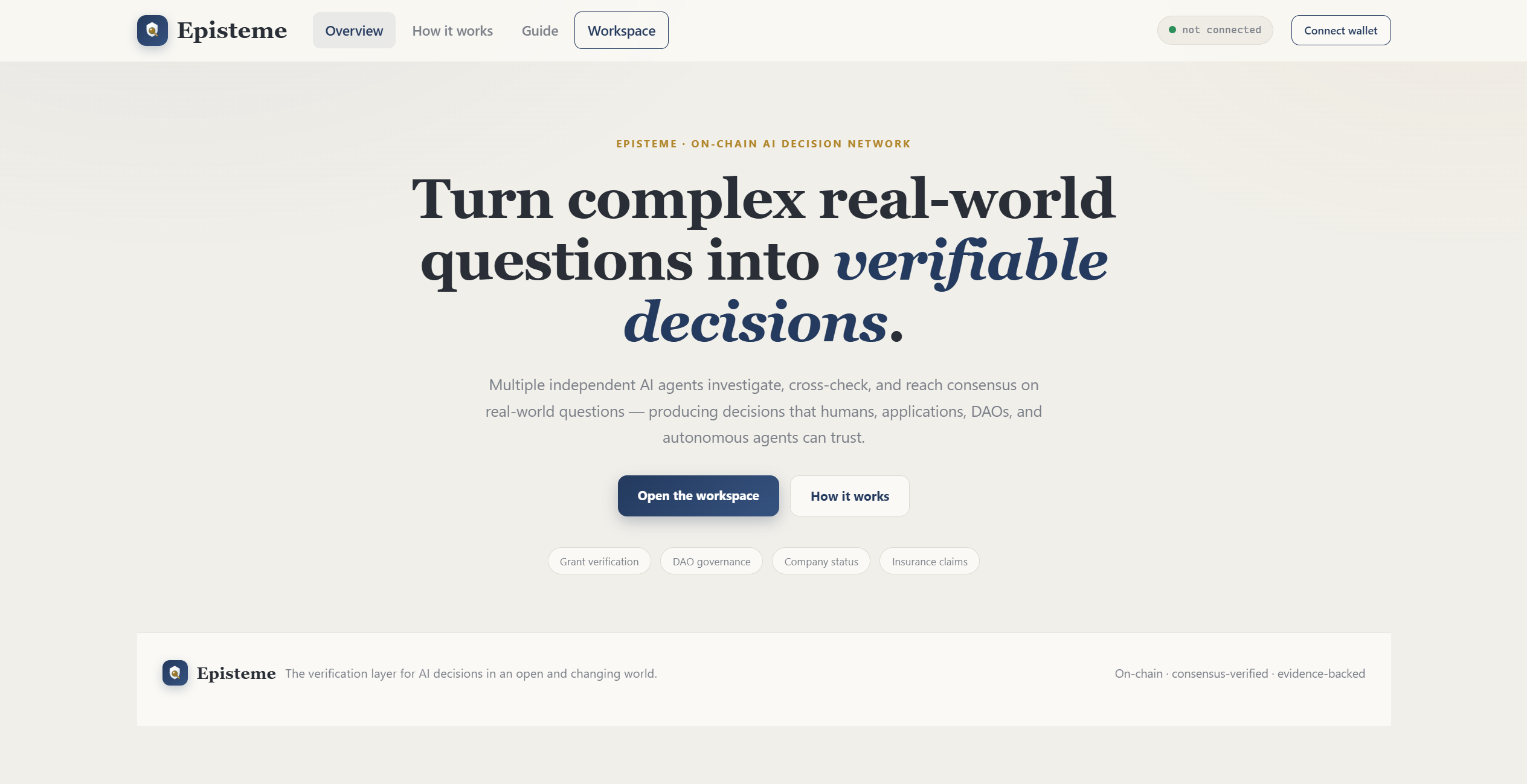
Episteme is the verification layer for AI decisions in an open and changing world. It does not ask "What does AI think?" — it asks "Can an AI-generated conclusion survive independent investigation and challenge?" Instead of user → AI → answer, Episteme produces a verifiable decision: evidence-backed, independently challenged, consensus-verified, and versioned.

The Pipeline

Ask → Investigate → Challenge → Verify → Use

1. Ask — a user or application submits a question, a policy, and evidence URLs. 2. Investigate — five agent roles run inside the contract and read live web content: Research, Source quality, Fact-check, Analyst, Skeptic. 3. Aggregate — evidence is scored against the policy's criteria. 4. Challenge — the skeptic hunts for contradictions; anyone can open a public dispute. 5. Verify — GenLayer validators independently re-run the investigation and must reach consensus. 6. Use — a versioned, shareable record with full provenance.

Verifiable Decisions

A decision is an object, not a sentence

Every decision carries provenance: verification ID, decision (PASS/FAIL), confidence, status, consensus, criteria results, sources with category and authority, challenges, revision history, disputes, and an expiry date. It can be challenged, appealed, re-verified, and referenced — not just displayed.

Consensus, the way GenLayer designed it

Implements the Equivalence Principle: a leader proposes a result and validators independently re-run and compare. Decision class must agree, confidence must fall within tolerance, criteria results use direction tolerance (a PASS↔FAIL flip is never accepted), and evidence counters must be consistent. The verdict is genuine majority agreement of independent models.

Built for the Real World

One engine, many verticals

grant-v1

GitHub, GitLab, docs

Open-source grant eligibility

dao-proposal-v1

gov.uniswap.org, snapshot.org

DAO treasury proposals

company-status-v1

registries, official sites

Is an organization still operating?

insurance-claim-v1

flight trackers (required)

Did the claimed event occur?

service-status-v1

live APIs

Is a service live and returning valid data?

Robust by Construction

No party — not even the deployer — can manipulate a result

Immutable policies seeded at deploy, consensus on every mandatory criterion, sources bound to what was actually submitted, original URLs preserved in every revision, tx-returned verification IDs, owner-only re-verification with full revision history, dispute modes (public/parties), evidence provenance, anti-fake-evidence origin constraints, honest failure (NEEDS_REVIEW / INSUFFICIENT_EVIDENCE), expiry, events, and hard input limits.

Measured, Not Claimed

42 direct-mode tests

Including adversarial cases: duplicate register rejected, non-owner re-verify rejected, double dispute rejected, irrelevant evidence → FAIL, allowed_origins enforcement, fabricated-source and fabricated-citation rejection, and mandatory-criterion consensus. Accuracy: 8/8 against ground truth with unanimous consensus. genvm-lint check passes with no forbidden patterns.

Contract

ItemDetail
NetworkGenLayer StudioNet
Contract0x8934dfd22A3CF8082B443AF80786da2EFE646f08
Writeverify_with_policy, challenge, reverify (owner-gated)
REST APIhttps://episteme-verify.vercel.app/api/verify, /challenge, /reverify, /policies, /verifications

Security & trust model

No admin keys — the deployer has no special power after deploy. The only writes are verify_with_policy, challenge, and owner-gated reverify. No silent rewriting — re-verification appends to revision history; disputes are append-only.

More projects