How GenLayer Reaches Consensus Without Trusting Anyone
The problem with AI on the blockchain
Most blockchains are deterministic by design. Run the same code with the same input on a thousand nodes, you get a thousand identical outputs. That's how you get consensus — everyone agrees because there's literally nothing to disagree about.
Now introduce an LLM. Ask it "is this news article accurate?" and you might get slightly different answers depending on which model is running, what temperature it's set to, or even just the time of day. Two validators running the same contract could produce outputs that are word-for-word different but mean exactly the same thing.
Traditional blockchain consensus breaks here. You can't just hash the outputs and compare — they'll never match.
This is the problem GenLayer's Optimistic Democracy solves.
What is Optimistic Democracy?
Optimistic Democracy is GenLayer's consensus mechanism for Intelligent Contracts — contracts that can call LLMs, fetch live web data, and make subjective decisions on-chain.
The "optimistic" part means the network assumes transactions are valid unless someone proves otherwise. The "democracy" part means a group of validators votes on whether the proposed output is acceptable.
It's designed around a simple insight: you don't need everyone to produce identical results. You need enough independent validators to agree that a result is good enough.
How it works — the full flow
How Optimistic Democracy Works — GenLayer Consensus Flow
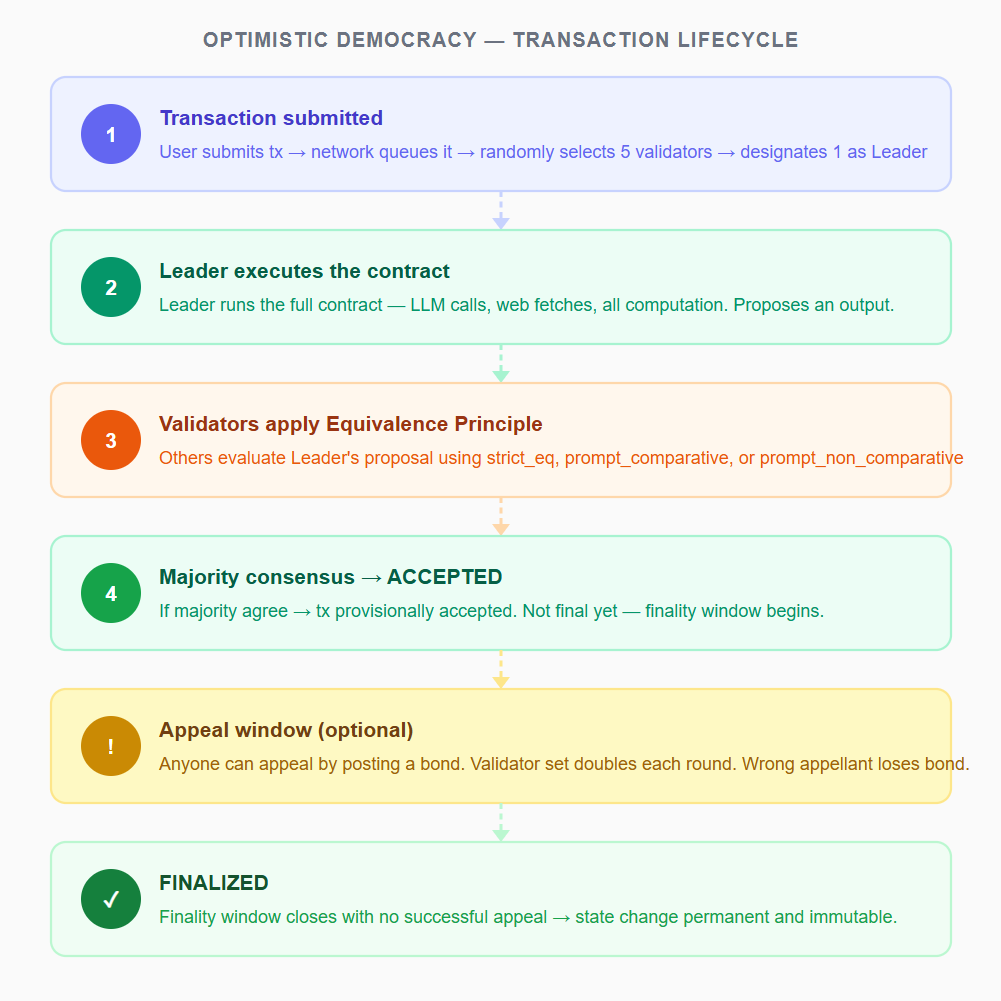
📤 Transaction submitted
Step 1
A user submits a transaction to an Intelligent Contract on the GenLayer network. The transaction is queued in contract-specific order and marked as PENDING. GenLayer randomly selects a small group of validators from the active validator pool to process this transaction. One is designated as the Leader.
⚙️ Leader executes the contract
Step 2
The Leader validator runs the Intelligent Contract — including any LLM calls or web fetches — and proposes an output. The Leader is the only one who actually executes the contract in full at this stage. This output becomes the proposed result for the transaction. Other validators will not re-execute — they will evaluate the Leader's proposal instead.
⚖️ Validators apply the equivalence principle
Step 3
Other validators independently check whether the Leader's output is acceptable using the Equivalence Principle defined in the contract. Depending on the contract's design, validators either: • strict_eq — compare byte-for-byte; • prompt_comparative — run their own LLM call to judge semantic similarity; • prompt_non_comparative — evaluate the Leader's output against predefined criteria without re-running.
✅ Majority consensus reached
Step 4
If most validators accept the Leader's output, the transaction is provisionally accepted and enters the Finality Window. The transaction status moves to ACCEPTED. This is not final yet — there is a time window during which any participant can challenge the result by initiating an appeal.
⚠️ Appeal window (optional)
Step 5
If anyone disagrees with the result, they can appeal during the Finality Window by posting a bond. The appeal round doubles the number of validators. A new group joins the originals. They first vote on whether to re-evaluate. If yes, a new Leader is chosen. Each escalation doubles validators again — this continues until consensus or all validators have participated.
🏁 FINALIZED
Step 6
After the Finality Window closes with no successful appeal, the transaction is permanently recorded on-chain. State is updated, the result is immutable. If an appeal was successful, the state reflects the corrected outcome. Validators who voted incorrectly are slashed (lose part of their stake).
💡 Hint
Click each step to expand details
Step 1 — Selected validators
👑 Leader
randomly selected
🔵 Validator 2
vote
🔵 Validator 3
vote
🔵 Validator 4
vote
🔵 Validator 5
vote
Step 4 — Possible outcomes
✓ Majority agrees
ACCEPTED (provisional)
✗ No majority
transaction fails or retried
Step 5 — Appeal tree
Round 1
5× V (original)
5 validators
Appeal 1
5× V (original) + 5× N (new)
10 validators (doubled)
Appeal 2
10× V (original) + 10× N (new)
20 validators (doubled again)
🔑 Correct appellant → rewarded. Incorrect → loses bond (slashing).
How it works, step by step
Step 1 — Transaction submitted
A user submits a transaction to an Intelligent Contract. The network queues it and randomly selects a small group of validators to process it. One of them is designated as the Leader.
The random selection is important — it prevents any single validator from consistently controlling outcomes.
Step 2 — Leader executes the contract
The Leader is the only one who actually runs the contract end-to-end. This includes any LLM calls, web fetches, or complex computations. The result becomes the proposed output for this transaction.
Step 3 — Other validators evaluate the proposal
Here's where it gets interesting. The other validators don't just re-run the contract and compare outputs byte-for-byte. Instead, they apply the Equivalence Principle — a developer-defined rule for what counts as an acceptable result.
Depending on how the contract is written, this could mean checking outputs byte-for-byte, running their own LLM to judge semantic equivalence, or evaluating against predefined criteria.
Step 4 — Majority consensus
If most validators accept the Leader's proposal, the transaction status moves to ACCEPTED. But this isn't final yet.
Step 5 — The finality window
There's a time window after acceptance during which anyone can appeal the result by posting a bond. If no appeal is filed, the transaction becomes FINALIZED.
Step 6 — Appeals
If someone appeals, the validator set doubles. Each subsequent appeal doubles the validators again. The financial incentive keeps this honest: if you appeal and you're wrong, you lose your bond. Validators who voted incorrectly get slashed — they lose part of their staked tokens.
Why this matters for developers
You don't control which validator runs your contract.
Consensus latency is real.
The appeal mechanism is your safety net.
The finality window is a feature, not a bug.
The bigger picture
Optimistic Democracy is what makes GenLayer's "trustless AI" claim meaningful. It's not just running AI on a blockchain — it's a structured mechanism for multiple independent AI-powered validators to reach agreement on subjective, non-deterministic outputs without any single point of trust.
Bitcoin solved trustless money. Ethereum solved trustless computation. Optimistic Democracy is GenLayer's attempt at trustless judgment.
This is part of a series of visual guides to GenLayer's core concepts. Next up: the Equivalence Principle — how validators actually decide if two different outputs mean the same thing.