Glyphwright — Forge Spells in Plain Language, Judged by an AI Council
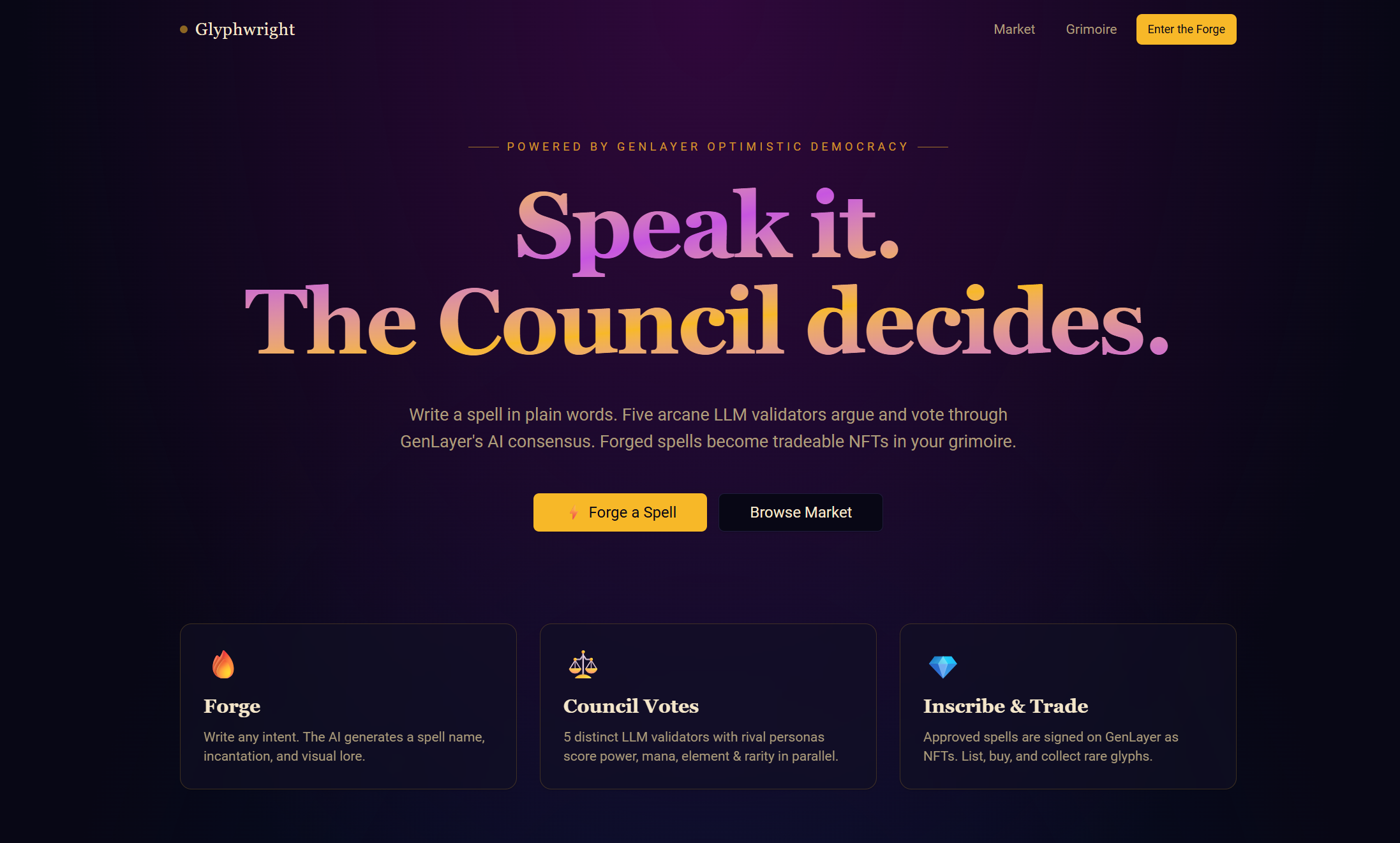
Glyphwright is an arcane crafting game where players write the intent of a spell in plain language, and a council of five AI validators argue, vote, and decide whether it deserves to exist. Approved spells become tradeable glyphs in your on-chain grimoire, ready to be listed on an open marketplace.
The Idea
You don't pick from a menu of pre-made spells. You write the intent — something like "a whisper that makes someone forget the last sentence they spoke" — and the council takes it from there. Each of the five validator personas judges your spell with their own personality and bias. If at least 60% approve, your spell is forged: it gets a name, an incantation, lore, stats, and a permanent home in your grimoire.
What makes it different from "type a prompt, get an NFT" is the council itself. Five distinct AI personas — Pyromancer Ignis, Verdant Sage Liora, Voidcaller Nyx, Runesmith Borr, and Oracle Sephielle — each weigh in with their own voice, then have to reach consensus on the result. The score isn't decided by one model run. It's decided by validators agreeing on what the council collectively saw.
Key Features
Natural-Language Spell Crafting
Write the intent of your spell in plain English. The AI council generates the full realization — name, incantation, lore, and stats — based on what you described.
Five-Validator AI Council
Each persona judges across power, mana cost, element, rarity, and approval. Their votes happen in a single LLM round and are reconciled by GenLayer's consensus engine.
60% Approval Threshold
A spell is only forged if at least three of five validators approve. Stats are averaged, element and rarity are decided by majority vote — no single validator can dictate the outcome.
On-Chain Grimoire
Every approved spell is minted into your personal grimoire, keyed to your wallet address. Spells are permanent, tradeable, and provable on-chain.
Native GEN Marketplace
List any spell from your grimoire for sale in native GEN. Buyers pay in one transaction — ownership and payment transfer atomically. Sellers can delist anytime.
Mystical UI with Rarity Tiers
Each spell card glows with its element's color and is ringed by its rarity tier. The whole interface leans into the arcane theme — runes, glyphs, and gradients designed to feel like an actual spellbook.
Pages
- Landing — Hero, feature overview, and the gateway into the game.
- The Forge — Where you write spell intents, watch the council deliberate, and mint the winning spells.
- Your Grimoire — Collection view of every spell you've forged, with the option to list any of them on the market.
- Glyph Market — Browse all listings from every player, buy spells with native GEN, or manage your own active listings.
Why GenLayer's Optimistic Democracy?
Most onchain games either pre-define everything (boring) or hand creation off to a centralized server (defeats the point). Glyphwright sits in the middle — players generate something genuinely new each time, but the result is judged and recorded by validators that no single party controls.
Optimistic Democracy is what makes the AI council possible. Each validator runs the same prompt, the network compares their outputs, and the consensus result is what gets written to chain. It means the game's verdicts are reproducible and resistant to manipulation, while still leaving room for the kind of subjective judgment that makes magic feel like magic.
Built by dhozil on GenLayer Studionet